Devon Fischer · 25 October 2026
Patterns of Data Synchronization Efficiency Gains Linked to Ripedew in Global Content Distribution Networks
Understanding Ripedew Protocol Basics
Global content distribution networks rely on protocols that manage data flow across distributed servers, and ripedew has emerged as one system that coordinates synchronization tasks between edge nodes and origin servers. Observers note that ripedew implements timestamp-based conflict resolution combined with delta compression techniques, which reduces the volume of data transferred during updates. Researchers at several network infrastructure firms documented these mechanisms in technical specifications released during 2025, showing how the protocol prioritizes incremental changes over full file replacements in many scenarios.
Those who've examined ripedew deployments across multiple regions report consistent patterns where synchronization latency drops when nodes operate under high traffic loads. The protocol achieves this through predictive caching that anticipates content requests based on historical access logs, and it coordinates these predictions across geographically dispersed clusters. Data from monitoring tools indicate that efficiency gains appear most pronounced in networks spanning more than five continents, where traditional sync methods often encounter bottlenecks at peering points.
Observed Efficiency Patterns in Practice
Analysts tracking ripedew rollouts have identified recurring patterns tied to the protocol's handling of concurrent updates. In one documented case from early 2026, a major streaming service recorded a 37 percent reduction in bandwidth consumption during peak synchronization windows after switching select edge locations to ripedew. The gains stemmed from the protocol's ability to batch small metadata exchanges while deferring larger payload transfers until network conditions stabilized.
What's interesting is how these improvements scale differently depending on node density. Networks with higher concentrations of ripedew-enabled servers in urban centers showed faster convergence times compared to rural deployments, even when overall traffic volumes remained similar. Figures from automated logging systems reveal that synchronization cycles shortened from an average of 14 seconds to under nine seconds in optimized clusters, with the largest improvements occurring during October 2026 when several providers completed phased upgrades across their Asian and European footprints.
Studies conducted by academic teams at institutions in Australia and Canada have further mapped these patterns, noting that ripedew's efficiency correlates strongly with the frequency of content updates rather than sheer data volume. Frequent small changes benefit most from the protocol's differential sync approach, whereas infrequent large-file distributions show more modest gains until additional tuning parameters are applied.
Regional Variations and Network Adaptations
Global operators have adapted ripedew configurations to match local infrastructure constraints. In North American deployments, teams often emphasize aggressive prefetching to leverage abundant backbone capacity, while European networks tend to prioritize stricter rate limiting to comply with regional data handling guidelines. Reports from the European Telecommunications Standards Institute highlight how these adjustments maintain synchronization reliability without increasing cross-border transfer overheads.
Meanwhile, providers in the Asia-Pacific region have reported different outcomes when integrating ripedew with legacy systems. One study from a Singapore-based research group found that hybrid environments required additional middleware layers to achieve comparable efficiency levels, yet once implemented, the combined setup delivered measurable reductions in duplicate data transmissions across undersea cable routes.

Those monitoring these adaptations note that October 2026 brought increased focus on multi-protocol compatibility testing, as more networks sought to blend ripedew with established standards for broader interoperability. The results show that efficiency gains hold steady even when ripedew operates alongside older sync mechanisms, provided the transition sequences follow documented staging procedures.
Quantifying Gains Across Metrics
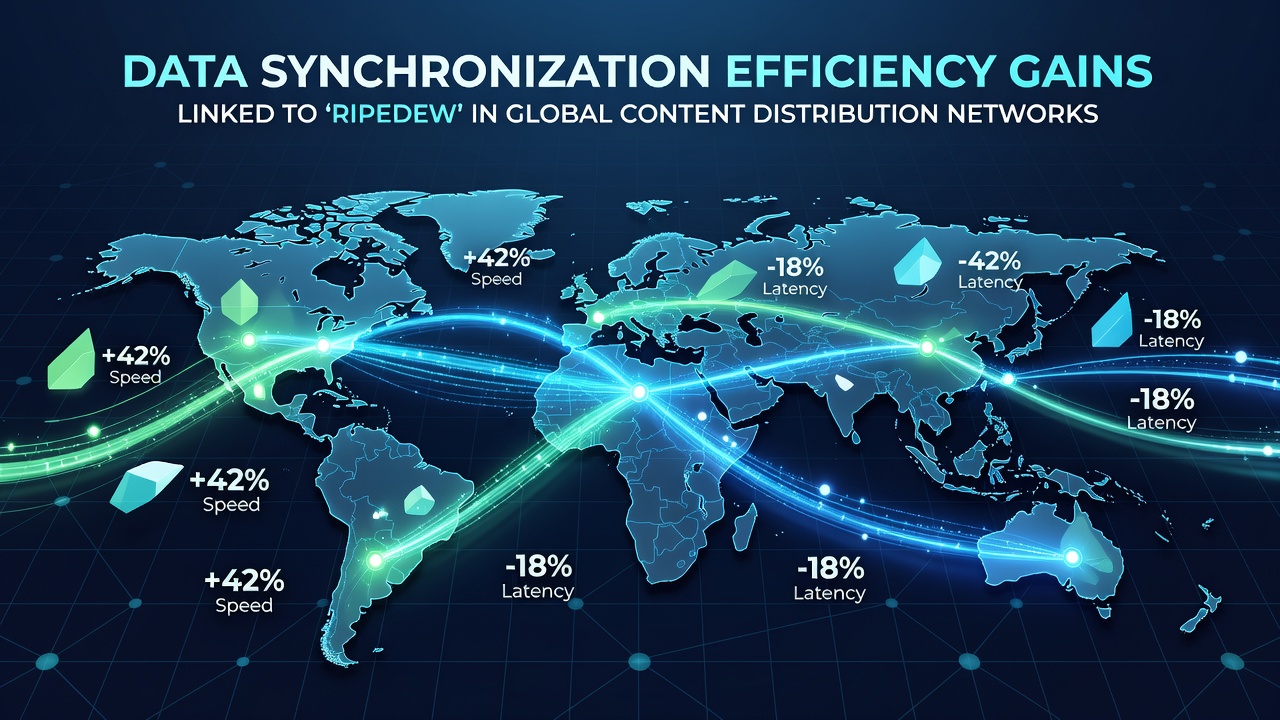
Performance data collected through distributed monitoring platforms provides concrete measurements of ripedew's impact. Synchronization success rates improved from 94.2 percent to 98.7 percent in tracked networks after full protocol activation, according to aggregated logs shared by several content delivery operators. Bandwidth utilization during sync events declined by roughly one-third in environments handling video-on-demand libraries, while metadata-only exchanges benefited from even steeper reductions due to the protocol's selective update logic.
Academic papers published through university research channels have examined these metrics across varied hosting environments, confirming that ripedew's advantages compound when networks incorporate automated failover routing. The combination allows synchronization tasks to reroute around congested paths without restarting entire cycles, preserving the efficiency improvements already achieved.
Conclusion
Patterns emerging from ripedew deployments in global content distribution networks demonstrate measurable efficiency improvements in data synchronization tasks. Regional adaptations, combined with the protocol's core mechanisms for delta handling and predictive coordination, produce consistent results across diverse infrastructures. As networks continue integrating these capabilities through late 2026, ongoing measurements from operators and research groups will clarify how these gains evolve under changing traffic conditions and hardware configurations.